
Matching Your Pasture Forage To Your Herd
Matching Your Pasture Forage To Your Herd
By Fay Benson
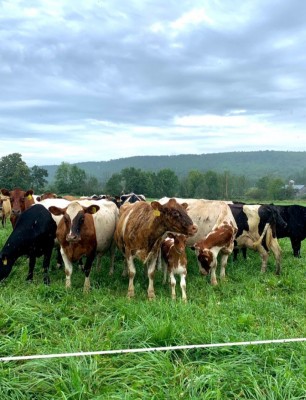
After being involved with grazing livestock for much of my life, first on my family's dairy then owning a grazing dairy, and finally working here at CCE, I am surprised that more grazing doesn't happen in the Northeast. We have a good climate for growing cool-season grasses which support the nutritional needs of all ruminant livestock including the lactating dairy cow. The cost savings are substantial since no machinery is required to harvest the forage, store the forage, put the forage in front of the cow, and on top of that, they spread their own manure. Then I consider the statement that "Grazing is an art" and I can understand why some farmers don't want to understand the complexities of grazing, considering the season is only 180-200 days a year. An essential component of this art is estimating the forage needs of the animal with pasture forage availability in the pasture.
I am only going to be describing rotational grazing in this article with a pasture residency or duration of 12 hours to 3 days. I believe the adage that the first day of grazing in the pasture is like eating in the dining room. The second day is like eating in the bedroom, and the third day is like eating in the bathroom. In order to make economic use of your pasture acreage, it's important to match the pasture size to your herd size. There are multiple reasons for this:
One of the costs that are often ignored in a pasture operation is the cost of owning the land. By matching your herd to the land base you can minimize this cost per animal.
To maximize dry matter production of the sward (mix of forage species that make up a pasture) it's important to allow for a proper rest period for the sward to recover. Too many animals will weaken and reduce pasture productivity, and too few will limit your profit potential.
Having more animals than the pasture can support will lead to overgrazing which leads to compaction and weakening the soil's health and its ability to support the higher-yielding pasture species.
The Math of Matching Pasture to Livestock
The following information was taken from the Pasture Map Tool
How to Calculate Stock Days / Acre (SDA)
This is the pasture inventory method popularized by folks in adaptive grazing or management intensive grazing. It's practical and only requires your boots, eyeballs, and some quick math.
Go out to pasture and pace off a square patch of pasture that you think will feed one Animal Unit (AU) per day. For reference, one standard Animal Unit (AU) is a 1000-pound steer, eating 3% of its body weight per day. This would be 30 lbs of dry matter per day. So this patch is going to feed one Animal Unit Day or one cow day.
Measure by paces how big your patch of pasture is. Count how many square yards your paced-off patch is. For example, 20×20 yards is 400 sq yards.
Divide to find how many cow-days one acre has to get Stock Days / Acre (SDAs). One acre has 4840 sq yards per acre.
In this example, 4840 sq yards / 400 sq yards = 12.1 Stock Days/ Acre.
Stock Days/Acre is a measure of how much grass you have. It's an indication of forage inventory and carrying capacity. You can use Stock Days/Acre (SDAs) to calculate an appropriate stocking rate for your animals. Once you've trained your eye, it will become easier for you to better at eyeballing SDAs on your pasture over time.
Eyeball forage inventory
If you'd just like a quick, but less accurate estimate of your pasture dry matter, all you need is an estimate or measurement of the forage height. Once you have the average height in inches of the forage in your pasture, multiply it by 200. This is an average estimate of pounds of dry matter per acre per inch of forage height. For example, if your grass is 10 inches tall, multiply 10 x 200 to get 2000 lbs/acre of dry matter. If you want to get a little more precise, use the table below to estimate. Just replace 200 with the relevant number below based on the type and health of forage you have in your pasture.
Rising Plate Meters
In my work with Extension, I like to have a quicker and more accurate way to evaluate the amount of dry matter both available and also consumed by the livestock. I use a Rising Plate Meter. This handheld tool combines height with the density of the pasture sward to provide a reading that can be calculated to give a more precise measurement of forage in a pasture. The rising plate meter consists of a thin aluminum plate mounted on a shaft by a gear connected to a mechanical counter (see picture). As the rod is lowered into the pasture, the plate is supported at a height determined by the sward's thickness, height, and the plants that compose it. On farms where accurate calculations are needed to not only give what's currently in a pasture but also to monitor the growth of all pastures. The monitoring allows graziers to get the most out of their pastures. If there is a predicted shortage in future pastures, they can lengthen the residency of the herd by adding stored forage. If there is an excess of future forage then some of the pasture can be harvested for stored feed. I will write more about this tool in the next Dairy Digest (and share on the blog).
Field Crops
Dairy
Business
Livestock
Grains
Upcoming Events
Livestock Production Field Day
August 29, 2026 : Livestock Production Field Day
Chaffee, NY and East Aurora, NY,
Join us on visits to Horizon Ridge Farm in East Aurora and Troll Bridge Farm in Chaffee for an introduction to small beef and small diversified livestock enterprises. Through walking farm tours, attendees will learn about management, meat processing, setting prices, and finding local markets. Dinner will be provided. Register by contacting Amy Barkley at amb544@cornell.edu or 716-640-0844.
Poultry Processing Workshop, Naples, NY
September 17, 2026 : Poultry Processing Workshop - Naples, NY
Naples, NY
This program is one of four statewide roadshow stops across the state, offering farmers a full poultry processing experience. The class will teach skills that build confidence, reduce costs, and strengthen your farm's independence. This hands-on workshop gives farmers the chance to process a bird from start to finish, learning every step of the workflow used by small farms across the state.
Large Animal Awareness Training For First Responders
September 19, 2026
Dunkirk, NY
Join the Chautauqua County Technical Rescue Services and NYS Veterinarian, Dr. Kate Card-Allen, for a specialized training on how to safely and effectively respond to large animal incidents. Learn techniques for managing large animals during traffic accidents, rollovers, entrapments and other transportation emergencies.
Announcements
No announcements at this time.