
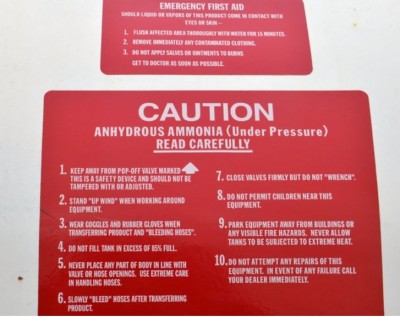
13 Safety Tips for Anhydrous Ammonia
By Tom Bechman, Farm Progress
You're hauling an anhydrous ammonia tank through town and the right rear rim falls off the anhydrous wagon. Would you know what to do?
Can't happen to you? It happened to an Indiana farmworker recently. The secret is reducing the odds for these things to happen — and knowing how to react if they do.
"We have training programs to help clients understand why anhydrous ammonia must be respected and what precautions you should take," says Marty Huseman, safety director for Good Days Work, Brookston, Ind.
Recently, Huseman sent reminders related to working around anhydrous ammonia to his clients. Here are 13 anhydrous safety tips from Huseman:
1. Remind and retrain. Family members, full- and part-time employees, and new hires all need training and refresher courses on anhydrous ammonia safety, Huseman says. "You don't work around it every day, and it's easy to forget key points," he says. "Safety needs to be top of mind."
2. Smell it. Anhydrous ammonia is colorless, but it has a recognizable odor. If you smell it, identify the source immediately.
3. Understand its deadly love of water. Anhydrous ammonia has a strong affinity for water, and sucks it out from everywhere, including your eyes. Living tissue is destroyed quickly and will not heal.
4. Remember it's lighter than air. Vapor from anhydrous ammonia moves up into the atmosphere. However, high humidity traps vapor. When ammonia encounters moisture, vapor becomes heavier, settling in valleys and road ditches.
5. Protective gear is essential. Unvented goggles and a full-face shield protect you from a release, Huseman says. Rubber gloves impervious to ammonia protect you as well. A heavy-duty long-sleeved shirt, long pants and respirator are recommended.
6. Use water as first aid. It takes large amounts of water to neutralize effects on the body. Start water treatment immediately, Huseman says. Make sure you have water available. Check the water supply on the side of the anhydrous tank.
7. Never go through town. The first mistake the farmworker in the example made was driving through town. Take a route that avoids towns and people.
8. Don't make any stops. Did you know it's a violation of federal law to leave a nurse tank and towing vehicle unattended? Tow the tank straight from the retailer to the field — no exceptions!
9. Observe 25 mph speed limit. Anhydrous ammonia tanks carry a slow-moving vehicle sign for a reason, Huseman says. Top speed should be 25 miles per hour. Most tires on these trailers are only rated up to 25 miles per hour.
10. Secure safety chains. Make sure safety chains are crossed and secured. Use a properly rated hitch pin with clip or keeper. Inspect each time before pulling onto the road, Huseman advises.
11. Allow time to stop. Increase stopping distance for a partial or heavy load. If you're pulling with a half-ton pickup, you don't have the same braking equipment as a ¾-ton or 1-ton truck. Allow more following and stopping distance.
12. Close valves. Turn off tank valves and disconnect hoses before pulling onto the roadway.
13. Know wind direction. Be aware of your surroundings, including knowing wind direction. Always work upwind in case of an accidental release, Huseman cautions.

Field Crops
Dairy

Business

Livestock

Grains
Upcoming Events
Poultry Processing Workshop, Canandaigua, NY
September 17, 2026 : Poultry Processing Workshop - Canandaigua, NY
Canandaigua, NY
This program is one of four statewide roadshow stops across the state, offering farmers a full poultry processing experience. The class will teach skills that build confidence, reduce costs, and strengthen your farm's independence. This hands-on workshop gives farmers the chance to process a bird from start to finish, learning every step of the workflow used by small farms across the state.
Tax 101: An Introduction to Income Taxes for Farmers
September 17, 2026 : Tax 101: An Introduction to Income Taxes for Farmers
Join NY Farm Net for a FREE mid-day webinar about income tax basics for farmers. Attendees will learn what documents you need, options for recordkeeping systems, how identify common tax forms and schedules, and more!
Large Animal Awareness Training For First Responders
September 19, 2026
Dunkirk, NY
Join the Chautauqua County Technical Rescue Services and NYS Veterinarian, Dr. Kate Card-Allen, for a specialized training on how to safely and effectively respond to large animal incidents. Learn techniques for managing large animals during traffic accidents, rollovers, entrapments and other transportation emergencies.
Announcements
No announcements at this time.