
Hay or Nay? Should you provide hay to pre-weaned dairy calves? by Casey Havekes
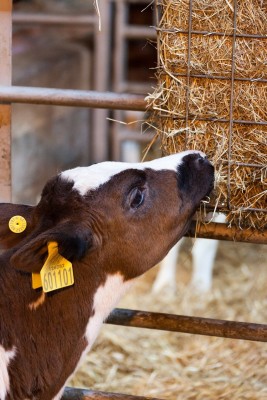
Hay or Nay? Should you provide hay to pre-weaned dairy calves?
A common question that Lindsay and I receive from dairy farmers is: "Should I be giving hay to my pre-weaned calves?" I think this question stems from varying opinions from industry experts over the past several decades resulting in conflicting views on whether hay provision for young calves is
beneficial or detrimental. For that reason, I reached out to Dr. Emily Miller-Cushon who is a professor of Animal Science at the University of Florida. Emily has spent the past several years intensely researching hay provision for pre-weaned calves. Emily agreed to participate in a podcast interview (click here to listen), but I wanted to take the opportunity to broadcast the information she provided in written form as well.
Emily first acknowledged that providing hay to calves is a controversial topic for dairy farmers and that there are many sources of variation that could influence how calves respond to hay provision. For example, the type of hay, physical characteristics of the hay, the type of solid feed, milk feeding
level, and social environment are all areas to consider, and Emily emphasized the point that what works for one farm may not work for another, and that ultimately you have to watch how your calves respond. Furthermore, Emily recognized that many farmers are under the impression that hay will interfere with starter intake. However, this common opinion is actually not backed by recent research. In fact, research in the last 5 years has found the opposite and has demonstrated that hay provision may increase starter intake, improve feed efficiency, result in higher average daily gain, and promote rumen health. Emily further explained that in two recent studies it was found that calves that had free choice access to chopped hay consumed more total solid feed compared to calves that were not offered hay. Please note that those calves provided with hay actually did not consume any more starter than their counterpart, but because they also consumed the hay it resulted in increased total solid feed intake.
One of Emily's primary research focuses over the years has been on the behavioral benefits of providing calves with hay and the results from
her research are quite fascinating. Emily explained how when provided with hay, calves spend more time eating throughout the day
which indicates that they are experiencing more variable foraging behavior and perhaps it gives them something to do with their time. The
results from her research suggest that calves actually enjoy consuming the hay and, in some circumstances, they preferentially select for the
hay. Specifically, during the early milk phase, when fed a mixture of solid feed and chopped hay, calves actually preferred to consume the hay versus
the starter. Even more interesting, however, is that when their nutrient requirements begin to change later in the milk phase, they sorted more in favor of the starter and less in favor of the hay. This result implies that calves will sort in favor of the feedstuff that best suits their nutritional demand. The fact that the calves preferred to consume the hay versus the starter during the early milk period may be perceived negatively; however, I think it is important to note that during this time milk is their primary energy source, not starter, and as such this behavior will not interfere with growth or development. An important consideration given these results, is that sorting is a learned behavior. If possible, provide hay separate from starter so that calves don't learn the sorting behavior early in life.
An additional benefit from providing hay that Emily highlighted is the reduced non-nutritive oral behaviors that calves perform. We often see calves cross sucking or preforming pen directed sucking behaviors (on buckets, nipples, bars etc.,), but providing hay may reduce these behaviors by giving the
calves something to chew on, or manipulate and this benefit is even more evident as calves approach weaning.
One last benefit that Emily highlighted was the potential impact that hay provision has on cognitive development. Emily explained that exposure to different feedstuffs early in life can promote acceptance of novel feeds later in life, as well as it may facilitate learning development. As calves develop, we want to make sure that they are able to adapt to a changing environment and that they aren't set back from small changes that they are bound to experience (diet changes, pen changes, weaning, etc.,). While more research is needed on this particular topic there is evidence that suggests providing hay can positively effect calves' learning ability.
Lastly, Emily points out that in her opinion a calf is never too young to have access to hay. According to the FARM 4.0 requirements, calves are required to have starter and water access by 3 days of age and Emily suggests providing hay at the same time. The calf may not consume the hay right away but she will at least get used to it and maybe sniff it or play with it. The hay that you provide also does not have to be the best quality hay that you have. You can easily get away with feeding low quality hay or even straw, if you have access to it.
In summary, providing hay to calves has many behavioral benefits and it's something that Emily highly recommends to promote behavioral development and even growth. However, there are several considerations that could influence the success of this strategy, including management. If you have
further questions regarding this topic please reach out to me (cdh238@cornell.edu; 315-955-2059) and I would be happy to help.
Hay or Nay Article (pdf; 383KB)

Field Crops
Dairy

Business
Livestock

Grains
Upcoming Events
Tractor Safety Workshop
August 20 - August 22, 2026
Cherry Creek , NY
August 20 - August 22, 2026
Cows, Crops & Critters - Southwest New York Dairy, Livestock & Field Crops Newsletter Sponsorship
December 18, 2026
Our two forms of publications feature research-based and timely information from our four specialists, listed to the right, along with local event notifications and Cornell University outreach. This information is provided to participants who range from dairy, livestock, and field crops producers to agricultural suppliers and consultants.
Weekly Email Update: Shared with 625+ households who have signed up with our program.
Monthly Paper Mailer: To reach our stakeholders and farmers who lack internet access, we send out a monthly mailer where your company's logo and contact information would be featured with a mailing list of 330+ households.
If you sponsor our weekly and monthly publications you reach approximately 955 households.
Visit our website to view our newsletters!
Paper Copy of Cows, Crops & Critters Newsletter (for recipients outside of 5 county region) July 2026-June 2027
May 31, 2027
To be more environmentally friendly and make sure our resources go directly toward our mission, we have been updating how we share news from Cornell Cooperative Extension's Southwest New York Dairy, Livestock and Field Crops Team.
You will continue to receive newsletters quicky and conveniently through email every month!
Announcements
No announcements at this time.